
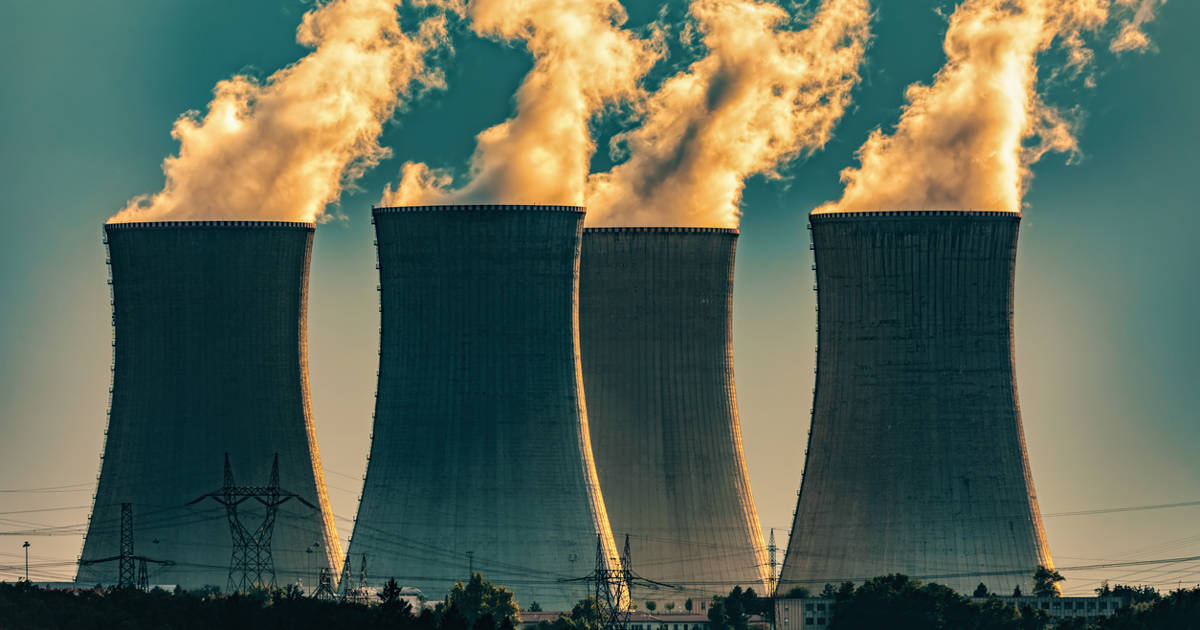
The government will discuss today, the 23rd, whether to continue operating the first nuclear power plant since the nuclear phase-out policy. The Nuclear Safety and Security Commission (NSSC) will resume deliberations on the approval of continued operation of Gori Unit 2 at 10:30 a.m. on the 23rd. Korea Hydro & Nuclear Power is pushing to extend the operational lifespan of Gori Unit 2 by up to 10 years.
The decision on whether to continue operating Gori Unit 2 is also significant as it could influence future decisions on extending the operation of aging nuclear reactors. Gori Units 3 and 4, Hanbit Units 1 and 2, and Hanul Units 1 and 2 have also applied to the NSSC for deliberations on continued operation approval.
◇Will the Lifespan of Gori Unit 2 Be Extended?
Located in Gijang-gun, Busan, Gori Unit 2 is the second nuclear power plant in the country, which began construction on May 26, 1977, and started commercial operation on August 10, 1983. Korea Hydro & Nuclear Power halted power generation at 10 p.m. on April 8, 2023, when its operational permit expired, and has since proceeded with maintenance and other procedures to prepare for continued operation.
Continued operation is a system that allows a nuclear reactor whose design lifespan has expired to operate for an additional 10 years if a safety evaluation finds no issues.
If a decision to continue operation is made, it will be the third such case in history, following Gori Unit 1 in 2008 and Wolsong Unit 1 in 2015, both before the nuclear phase-out policy.
The NSSC deliberations held on the 25th of last month failed to reach a conclusion due to the need for supplementary materials and further review at the time.
The decision on whether to continue operating Gori Unit 2 is also significant as it could influence future decisions on extending the operation of aging nuclear reactors. Gori Units 3 and 4, Hanbit Units 1 and 2, and Hanul Units 1 and 2 are also awaiting NSSC deliberations on continued operation approval.
◇“If Safety Is Guaranteed, It Should Be Extended”
This approval for continued operation of Gori Unit 2 is drawing further attention as it could reflect the stance of President Lee Jae-myung’s government on nuclear power.
At a press conference on the 11th of last month marking his 100th day in office, President Lee Jae-myung stated regarding the construction of one small modular reactor (SMR), a next-generation nuclear reactor, “It takes at least 15 years to build, and there is no site except one that was halted after starting construction,” “SMR technology is not yet developed,” and “If safety is guaranteed and a site is available, it could be built, but in my view, the feasibility is almost zero.” However, he also left room for maneuver by saying, “Even reactors past their operational period should be extended if safety is guaranteed, and those under construction should be completed well.”
Minister of Climate, Energy and Environment Kim Sung-whan, who inspected the Gori Unit 2 site on the 15th of last month, said, “We will achieve stable power supply, greenhouse gas reduction, and industrial competitiveness simultaneously through a balanced energy mix that expands renewable energy and operates safe nuclear reactors in parallel.”
Whether changes in the NSSC composition since the first meeting will be a variable is also drawing attention. The terms of Kim Gyun-tae, a doctor from the Korea Institute of Nuclear Safety recommended by the People Power Party, and Professor Je Mu-seong from Hanyang University expired on the 12th, excluding the two commissioners from the discussions. If delayed further, the term of Park Cheon-hong, former president of the Korea Institute of Machinery & Materials recommended by the Democratic Party, will also expire.
However, the NSSC, a nine-member deliberative body, requires a majority vote of more than half of the attending members (four out of seven) to pass a resolution, meaning a decision is still possible even if they withdraw.
The NSSC has sent an official letter to the National Assembly requesting the appointment of new commissioners to fill the vacancies, but there has been no significant movement from the National Assembly regarding the appointments.
◇Environmental Groups Protest
Environmental groups continue to oppose the continued operation of Gori Unit 2. Ahead of this deliberation, the Busan Citizens’ Coalition for a Nuclear-Free Future and the Environmental Movement Association held a press conference in front of the Seoul Administrative Court on the 20th, stating, “The NSSC deliberation process and prerequisite documents are illegal,” and filed a lawsuit to confirm the invalidity of the deliberation, along with a request for a provisional disposition to suspend execution.
In Jeonbuk, where the operational lifespans of Hanbit Units 1 and 2 are set to expire, the Korean Confederation of Trade Unions and others are voicing opposition to the extension. Their stance is that “the existing transmission grid used by nuclear reactors should be improved to facilitate renewable energy distribution and grid integration.”