
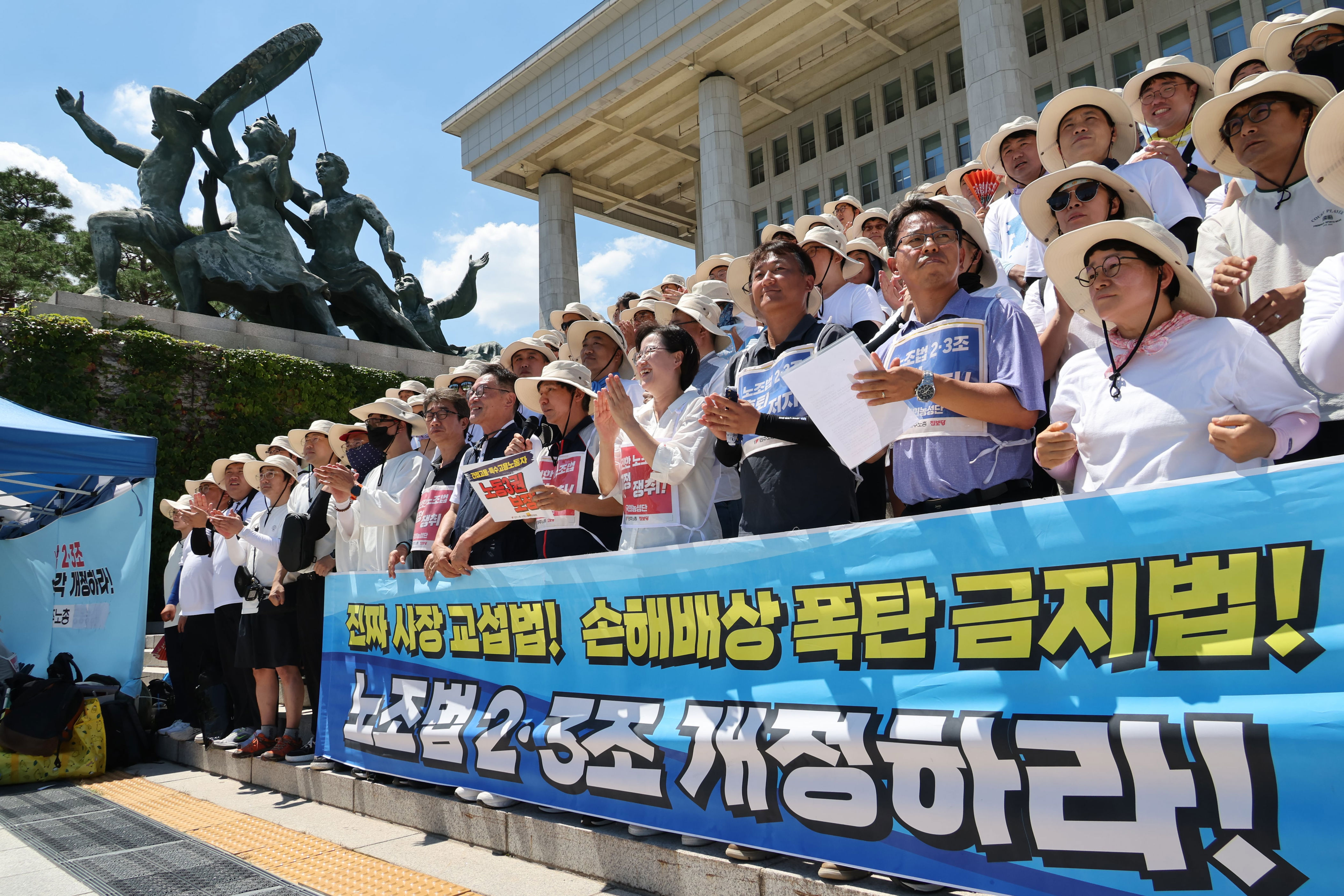
The Environment and Labor Committee of the National Assembly will hold a subcommittee meeting on July 28 to examine the so-called "yellow envelope bill," which aims to amend Articles 2 and 3 of the Trade Union and Labor Relations Adjustment Act. Led by the ruling Democratic Party, the bill may be approved by the subcommittee on the same day, signaling the beginning of a broader legislative initiative.
The bill was approved by the National Assembly twice during the Yoon Suk-yeol administration but was repeatedly stopped by a presidential veto. This time, the political environment has shifted, and the Ministry of Employment and Labor is now strongly backing the bill's enactment. The ministry has also released an updated version, which contains new clauses that some opponents argue grant unions excessive influence over management choices.
As per a revised version of the bill acquired by the Chosun Ilbo on July 27, the government intends to broaden the definition of labor disputes to enable unions to participate in significant management decisions. Existing legislation defines labor disputes as disagreements concerning "determining working conditions." A prior amendment proposed eliminating the term "determining" to encompass disputes related to the execution, application, or interpretation of agreed-upon conditions. Nevertheless, it encountered criticism that the ambiguous nature of "working conditions" would complicate the enforcement of the law.
The updated version clarifies the definition by incorporating both workplace conditions and business choices that influence them. The Ministry of Labor stated that the intention is to cover managerial actions, like large-scale firings, which directly affect employees' situations. Labor organizations claim the amendment weakens the bill, while business associations believe the more precise language strengthens it.
If approved, the amendments might enable unions to intervene not just regarding layoffs but also in high-level management choices, including investment strategies or moving operations abroad. The Korea Enterprises Federation cautioned that the legislation could essentially compel companies to obtain union consent for all significant business decisions.
Some business executives are concerned that the legislation might slow down critical restructuring or merger and acquisition activities, particularly in sectors affected by inexpensive Chinese imports and low local demand. Korean firms aiming to increase production in the U.S. because of tariff issues might also encounter resistance from unions, as this could lead to fewer jobs domestically. This situation could also impact overall supply chain strategies.
The legislation broadens the concept of an employer, although business organizations claim their issues were overlooked. Existing law defines an employer as the owner, a supervisor, or an individual acting on behalf of the employer. The updated bill encompasses any person who has authority over working conditions, even if they are not the primary employer. Business groups argue that this language remains the same as a previous version they had criticized.
This shift would enable subcontracted employees to initiate negotiations directly with the primary contractor. Attorney Hong Jung-seok from the Yoon & Yang law firm cautioned that companies such as Hyundai and Kia, which have numerous subcontractors, might face challenges in handling all these requests. He further noted that ambiguous definitions of employer could expose executives to potential legal issues.
Some professionals in the sector think the broader employer definition might exceed the scope of the Yellow Envelope Bill. An official mentioned that business leaders are concerned this could result in primary contractors directly employing subcontracted workers.