
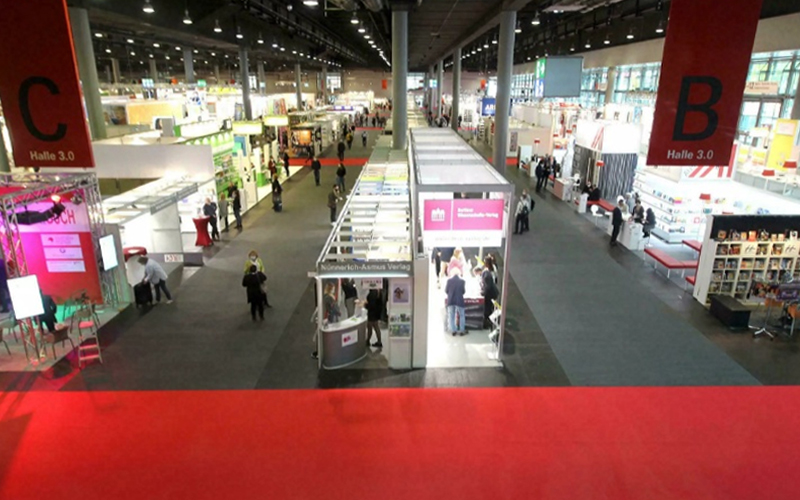
“Are there no Korean novels like Buldak Ramen?” This was the question posed by an Anglo-American literary agent to a domestic copyright representative at the 77th Frankfurt Book Fair (Frankfurter Buchmesse), held in Frankfurt, Germany, from the 15th to the 19th (local time). As the world’s largest book fair, this event is dubbed the “Sales Olympics of the Publishing Industry,” where global publishers gather. It occupies roughly half of the Messe exhibition halls (1–12), spanning an area equivalent to 56 soccer fields (400,000 square meters). This year, an estimated 238,000 visitors from 131 countries attended. Editors and copyright representatives from around the world, keenly interested in K-literature, tirelessly moved between Hall 5.1 (Korea Pavilion) and Hall 6.2 (Agency Center), searching for a “jackpot.”
◇“Korean Literature: An Idea Factory”
Korean literature is currently sizzling in the global publishing market. Two to three years ago, so-called “healing novels” exploded in popularity, particularly in the Anglo-American sphere. This momentum further accelerated last year with Han Kang’s Nobel Prize in Literature. While Frankfurt was once a destination for domestic publishers to “import” foreign works, it has now become a key gateway to “export” Korean authors’ creations.
On the 14th, the lobby of the Frankfurter Hof Hotel in Frankfurt’s financial district was packed. For two days before the fair’s opening, publishing professionals from across the globe gathered here for intense negotiations to secure titles. Meetings, split into 30-minute intervals, proceeded breathlessly, with participants exchanging cheek-kissing greetings and networking. It was a bustling marketplace for the publishing industry’s inner circle.
Scenes of people sitting on stair landings to spread out documents were common. “This novel is set in 16th-century Argentina…” Sales pitches began. Similar conversations echoed from all directions. Domestic copyright agencies and publishers, including BC, Shinwon, and Eric Yang, were also busy promoting Korean literature.
Paul Engles, an editor at Hachette Imprint Quercus in the UK, met during the event, remarked, “Korean literature is a bit like an ideas factory” and added, “Some the of most inventive books in world fiction have emerged from Korea in recent times.” He secured the rights to Kim Cho-yeop’s *If We Cannot Go at the Speed of Light* and is preparing for its publication next year. “It’s one of the most engaging and mind-bending short story collections I’ve ever read.”
◇Expanding Sales Channels Worldwide
After the fair’s opening, these professionals moved to the Agency Center in Hall 6.2. This area, inaccessible without reservations, was intensively covered from the 15th to the 17th. Publishers had been scheduling meetings with agencies here for at least six months in advance. Upon entering the hall, filled with 591 agency tables, the room buzzed with noise measured at around 75dB—equivalent to a vacuum cleaner running nonstop.
Paolo Caruso, an editor at Italy’s Casa Editrice Nord, stated, “Healing novels from Korea have been trending in Italy for five years.” Even France’s venerable literary publisher Calmann-Levy, which has not yet published Korean literature, was knocking on doors by requesting meetings. Jackie Yang, agent of Eric Yang Agency, noted, “Korean literature is now expanding its reach to countries like Romania, Hungary, and Denmark.”
On the 16th, this reporter sat in on a meeting between Doubleday (Penguin Random House’s literary imprint), Jaeum&Moeum Publishing, and Shinwon Agency. “This one seems ephemeral. We prefer works with universal appeal and a clear concept. Do you have any novels that blend realism and fantasy?” Jane Lawson, a veteran publishing director with 30 years of experience, gave immediate feedback on the Korean agencies’ proposals. Introductions to the next works followed. Last year, Doubleday paid over 200 million Korean won in advance for the rights to Kang Ji-young’s novel *Ms. Sim Is a Killer*.
Lawson described Korean literature as “bold. It examines dark corners and connects them to social issues with originality. That’s the secret to captivating young readers.”
◇K-Culture Nurturing K-Literature
Overseas publishers prefer works adaptable to film and focus on genre-driven novels, differing from domestic literary trends. Renowned Anglo-American publishers were busy seeking the next trend after “healing novels.” This year, rumors spread that they were scouting works featuring K-pop. Major Korean agencies focused on promoting monster- or shamanism-themed works, capitalizing on the global hit Netflix animation *KPop Demon Hunters*.
Overseas publishing professionals emphasized that the influence of K-culture, not just the “post-Han Kang” effect, has been pivotal. Tara Parsons, deputy publisher at HarperOne (HarperCollins), stated, “K-literature cannot be separated from K-culture. We must recognize its expanded influence as an entertainment industry.”
The recognition of Korea’s “literary achievement” following Han Kang’s Nobel Prize was also evident. RCW Agency, which represents Nobel laureates like Kazuo Ishiguro, Olga Tokarczuk, and Han Kang, recently signed Park Sang-young, author of *The Love in a Big City*.
Ann Viratkaphan, managing director of Thailand’s Amarin Publishing, which published *The Uncomfortable Convenience Store*, said, “We are closely watching Korea’s serious literary works since Han Kang’s Nobel win.” Richard Hong, CEO of BC Agency, remarked, “The current global perception of Korean literature balances commercial and literary works. This is a crucial period for its next-level upgrade.”
※This article was produced with support from the Korea Press Foundation.