
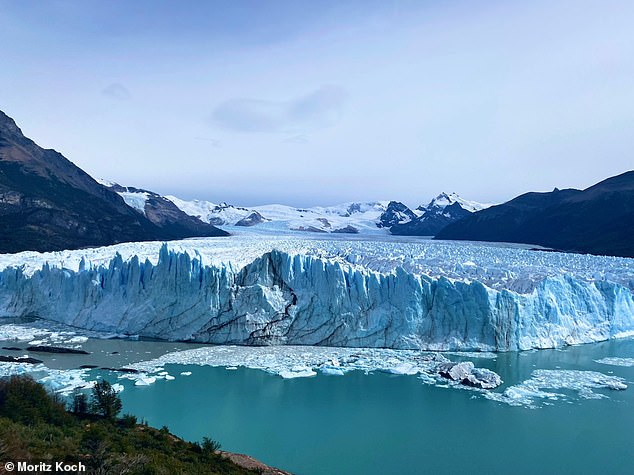
The Perito Moreno Glacier: A Natural Wonder on the Brink
The Perito Moreno glacier, located in southern Argentina, has long been regarded as one of the most stable glaciers on Earth. Stretching 19 miles (30 km) in length and covering an area of 95 square miles (250 sq km), it is a remarkable natural wonder that has captivated scientists and tourists alike for decades. However, recent studies reveal a troubling reality: this iconic glacier is now at risk of total collapse due to the accelerating effects of climate change.
According to research conducted by German scientists, the Perito Moreno glacier is experiencing a rapid decline in both thickness and length. This shrinkage is leading to a significant reduction in its overall mass, raising concerns about its future survival. The study, led by Moritz Koch, a PhD student at Friedrich-Alexander University of Erlangen-Nuremberg, highlights how climate change has already begun to alter one of the planet’s most spectacular natural phenomena.
Glaciers are more than just frozen rivers; they play a crucial role in regulating global temperatures and storing freshwater. Their reflective surfaces help cool the planet by bouncing sunlight back into space, while their melting provides essential water sources for millions of people. If all glaciers were to disappear, sea levels would rise dramatically, leading to catastrophic consequences such as coastal flooding, displacement of populations, and damage to infrastructure.
A Changing Landscape
Satellite imagery from March 2020 to March 2025 shows the dramatic retreat of the Perito Moreno glacier. Once considered stable despite widespread regional glacier retreat, the glacier is now undergoing a transformation that scientists have only recently begun to understand.
To assess the glacier's current state, researchers used advanced technology, including ground-penetrating radar systems mounted on helicopters. This equipment allowed them to map the previously unknown bedrock beneath the glacier, providing valuable insights into its structure and development over time.
From 2000 to 2019, the glacier lost about 13.3 inches (34 cm) of thickness per year, a relatively slow rate of melting. However, this trend accelerated significantly between 2019 and 2024, with the glacier losing up to 18 to 21 feet (5.5 to 6.5 meters) per year. Every 12 months, the ice thickness decreased by the height of a house, marking a concerning shift in the glacier’s stability.
Key Facts About the Perito Moreno Glacier
- Location: South Argentina
- Length: 19 miles (30 km)
- Area: 95 square miles (250 sq km)
- Age: Approximately 18,000 years
- Terminus: Lago Argentino
- Status: Retreating
In addition to becoming thinner, the glacier is also shortening. Some areas have retreated by more than 2,600 feet (800 meters) since 2019. The northern margin of the glacier, in particular, has shown significant retreat, with more than 800 meters lost in some regions. This uneven retreat is influenced by variations in lake depth, which affect how the glacier interacts with its surroundings.
The Role of Subglacial Features
One of the key findings of the study is the presence of a large rocky ridge beneath the glacier’s terminus. This feature may have contributed to the glacier’s previous stability. However, as the glacier continues to thin, it risks detaching from this ridge, which could lead to even faster retreat. While the exact timing of this event remains uncertain, scientists warn that continued thinning could trigger a rapid and irreversible loss of the glacier.
Currently, the glacier divides Lago Argentino, the largest freshwater lake in Argentina. As the ice becomes lighter and less dense, the water beneath the glacier provides increased buoyancy, causing more ice to break off from the terminus. This process accelerates the glacier’s retreat, creating a feedback loop that further threatens its existence.
A Wider Pattern of Glacial Retreat
The Perito Moreno glacier is not an isolated case. It is following a similar pattern observed in other calving glaciers in Patagonia, the southern region of South America. Scientists note that the glacier is undergoing its most substantial retreat in the past century. This trend is part of a broader global phenomenon, where many glaciers are disappearing at an alarming rate.
A recent initiative called the "Global Glacier Casualty List" has documented glaciers that are either already gone or are expected to vanish under current climate conditions. The list serves as a stark reminder of the scale of glacial loss and the urgent need for action to mitigate the impacts of climate change.
Conclusion
The Perito Moreno glacier, once seen as a symbol of stability, is now facing an uncertain future. Its rapid retreat highlights the profound impact of climate change on natural systems and underscores the importance of global efforts to address environmental challenges. As scientists continue to monitor this iconic glacier, the lessons learned from its decline will be critical in understanding and responding to the broader crisis of glacial loss worldwide.