
The Spread of a False Narrative
On Monday, pro-Kremlin news outlets and social media platforms shared a sensational report claiming that two British special forces officers and an MI6 operative had been captured in Ukraine by Russian authorities. If true, this would represent a significant victory for Russian President Vladimir Putin, potentially boosting morale during a period of heightened tensions between Moscow and London.
The report, published by EADaily, a Moscow-based website known for echoing Russian state narratives, alleged that Colonels Edward Blake and Richard Carroll, along with an unnamed British intelligence officer, were caught in a Russian operation near the front lines. It claimed they were "preparing a provocation or participating in sabotage operations" on Ukrainian territory. The story cited the Norwegian website Steigan.no, which has a history of publishing anti-Western and conspiratorial content.
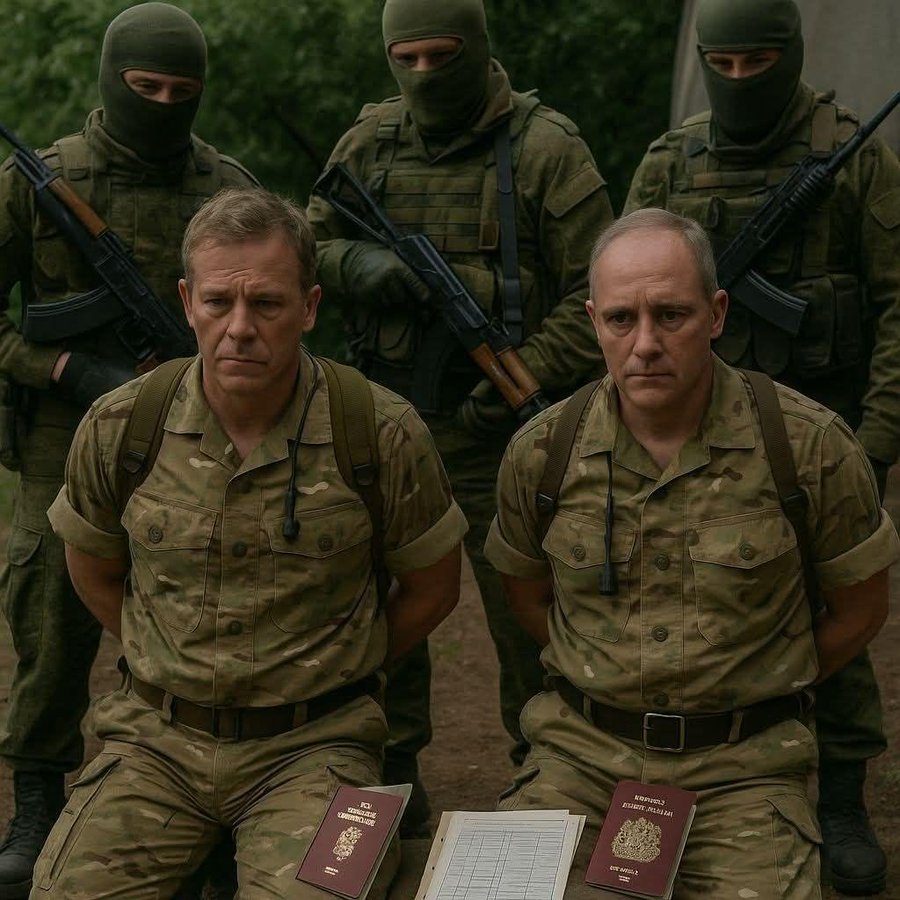
According to the article, the "prisoners" were found with "military documents and diplomatic passports." Initially, the UK stated they were tourists before offering a prisoner swap "in the hope of exchanging them for detained Russian servicemen." The article was accompanied by a photograph showing two men in army uniforms, hands behind their backs, kneeling beneath masked men in military uniforms holding assault rifles. This image was designed to showcase Russia’s ability to thwart sophisticated attacks.
Political Figures Amplify the Story
The image quickly spread across pro-Russian Telegram channels, X (formerly Twitter), and Facebook, where users claimed the capture was proof of direct British involvement in covert operations against Russian forces. The report was shared on X by former Conservative MP Andrew Bridgen and former Labour MP George Galloway, now leader of the Workers Party of Britain. Galloway tweeted: “Russia nets two British colonels and MI6 spy in Ukraine.” In a post viewed 68,000 times, Bridgen claimed the capture demonstrated how deeply the UK government had involved the country in a proxy war against Russia without informing the public.
An analysis by The i Paper showed that the first post about the story had over 150,000 views, with more than 18,000 views on X. However, the narrative and imagery made it difficult for many to ignore. The only problem is that the entire story is false. The so-called colonels do not exist, and the image accompanying the story is almost certainly generated by artificial intelligence, according to digital analysis conducted by this newspaper.
Disinformation and Its Impact
Dr Joe Devanny from the King’s College Department of War Studies noted that disinformation does not need to be sophisticated to have an impact. He questioned whether governments needed to intervene directly to "cut disinformation campaigns off at source." He emphasized that this episode highlights the ongoing Russian campaign to pollute the information sphere in the UK and elsewhere, calling it a relatively costless effort for Russia.
UK officials have dismissed the claims, with a Ministry of Defence source confirming there is absolutely no truth to the story. The report is part of a broader rhetoric from the Kremlin blaming the UK for sabotage attacks on Russia. Claudia Wallner, research fellow at RUSI, noted that while the story may not be true, it holds strategic value as a deterrent signal to Western states, a morale boost for domestic audiences, and a tool to discredit the UK internationally by portraying it as a direct saboteur against Russia.
A New Era of Information Warfare
Since Russia's full-scale invasion of Ukraine, the UK and Europe have experienced numerous suspected pro-Kremlin disinformation campaigns. Last year, several Russian agencies and individuals were sanctioned by the UK for undermining support for Ukraine using fake newspaper domains and lookalike Facebook accounts of media outlets, including the Daily Mail and BBC. An FBI investigation into the "Doppelgänger campaign" revealed a Moscow-directed influence campaign to manipulate politicians, journalists, businesspeople, and the public in the US, the UK, and Europe.
In response to these attacks, which officials openly accuse the Kremlin of, Vladimir Putin is now turning the script on the West, accusing the UK of launching its own hybrid warfare on Russia. On the same day as the fake reports, the SVR, Moscow’s foreign intelligence service, claimed that UK intelligence was plotting sabotage attacks on a fleet of Russian tankers known as the "shadow fleet."
Matthew Dunn, a former MI6 official, dismissed the claims as "fear-mongering propaganda, at best," noting that the allegations are more akin to Russia's own tactics. He pointed out that British military colonels are a precious commodity and would not be deployed just as a pair, nor are they trained spies.
Detecting the Fake
A closer look at the image reveals multiple red flags. Passports and documents inscribed with unreadable text float in the forefront, while none of the military uniforms contain badges. Attempts to trace any military history for "Colonel Edward Blake" or "Colonel Richard Carroll" come up empty. A Ministry of Defence source confirmed that neither of the names appears to be members of the British forces.
Using a renowned online facial recognition reverse search engine offered no hits at all for either of the "prisoners." Running the image through Sightengine, an AI identifier tool, determined with 99% assurance that the image had been created using ChatGPT4. While the image shows clear signs of being a fake and can be easily debunked, the rise of artificial intelligence makes disinformation campaigns increasingly hard to detect and more effective at shaping public opinion.
A UK intelligence source said that while "it may seem obvious" to be a fake story, many people around the world who consume their news through social media sites, such as Telegram, "will be duped" by these kinds of reports. By the time any official comment has been made, or fakery proven, the report has already spread globally and been seen millions of times. It marks another chapter in Russia’s evolving information warfare against the West, aimed at sowing doubt, division, and distrust.