
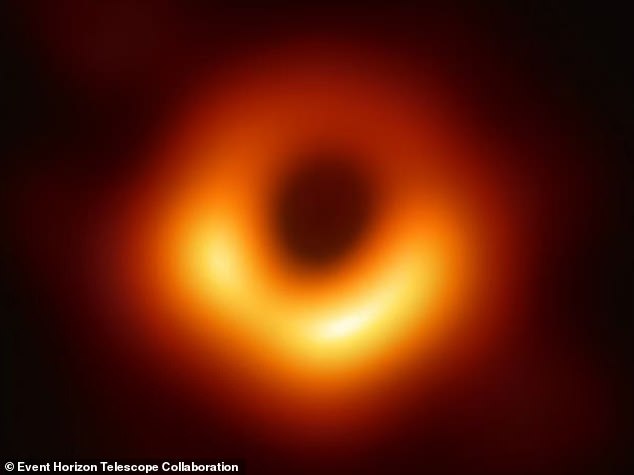
A Bold Vision: Sending a Spacecraft to a Black Hole
Imagine a mission that could redefine our understanding of the universe. Scientists are now proposing an ambitious plan to send a spacecraft into the heart of a distant black hole. This mission, if realized, would be one of the most extraordinary feats in human history. The concept involves creating a tiny spacecraft, no heavier than a paperclip, which would be propelled by powerful lasers and accelerated to nearly the speed of light. While the journey might take up to 100 years, the potential scientific rewards are immense.
However, this groundbreaking project comes with significant challenges. One of the biggest hurdles is the cost—up to £1 trillion for the lasers alone. Additionally, the technology required to build such a spacecraft does not yet exist. Despite these obstacles, Professor Cosimo Bambi from Fudan University in Shanghai remains optimistic. He believes that with time, money, and motivation, the mission could become a reality within a few decades.
Understanding Black Holes
Black holes are among the most enigmatic objects in the universe. They form when massive stars collapse into ultra-dense points where gravity is so strong that not even light can escape. Under these extreme conditions, the laws of physics as we know them start to break down and behave in unpredictable ways. Because black holes emit no light or radiation, they are incredibly difficult to study. This makes it challenging for scientists to understand their true nature and behavior.
Professor Bambi's proposal, published in the journal iScience, aims to probe the fabric of spacetime by sending a spacecraft directly into a black hole. For this mission to work, two key requirements must be met: a nearby black hole and a spacecraft capable of surviving the journey.
The Nanocraft Concept
To achieve this, Professor Bambi suggests using a nanocraft—a theoretical spacecraft designed to reach speeds approaching that of light. These miniature probes, weighing just a few grams, are attached to large, lightweight sails. Lasers on Earth or in orbit would bombard the sail with photons, accelerating the craft to a significant fraction of light speed. In theory, these nanocrafts could reach their top speed within minutes.
The idea is similar to the concept of using solar sails, but instead of sunlight, powerful lasers would provide the necessary thrust. Traditional spacecraft, which rely on chemical fuel, are too slow and inefficient for such a mission. However, with advancements in technology, the vision of a nanocraft could become a reality.
Challenges and Costs
Despite the promise of the nanocraft concept, several challenges remain. The nano-technology required to create such a spacecraft does not yet exist, and the cost of powering the lasers is enormous. Currently, using existing technology, the cost could reach around £1 trillion. However, Professor Bambi notes that if trends continue, the cost could drop significantly over the next 20 to 30 years, making the mission more feasible.
Another major obstacle is the distance to a suitable black hole. Professor Bambi emphasizes that the mission’s success depends on finding a black hole within 20 to 25 light-years from the Solar System. At that distance, the nanocraft would take about 70 to 80 years to reach the black hole, with an additional 20 to 25 years for data to return to Earth. This gives a total mission time of up to a century, which, while daunting, is still considered a viable goal.
If the nearest black hole is beyond 40 to 50 light-years, the mission becomes significantly more challenging. However, Professor Bambi believes that if a suitable black hole is found within the next five to ten years, the mission could be worth the astronomical price tag.
The Scientific Potential
Black holes offer an unparalleled opportunity to test Einstein’s theory of general relativity. Their intense gravitational fields make them ideal laboratories for studying how space and time react under extreme conditions. By taking accurate measurements of these regions, scientists could uncover deviations from theoretical predictions, potentially answering fundamental questions about the nature of physics.
Professor Bambi explains that the mission’s primary goal would be to compare measurements with the predictions of general relativity and look for any discrepancies. This could help determine whether the rules of physics change near a black hole or if Einstein’s theories hold up under the universe’s most extreme conditions.
Conclusion
While the mission to explore a black hole presents significant challenges, the potential scientific breakthroughs are immense. With continued technological advancements and the discovery of a nearby black hole, this bold vision could soon move from science fiction to reality. The journey may take decades, but the knowledge gained could revolutionize our understanding of the universe.