
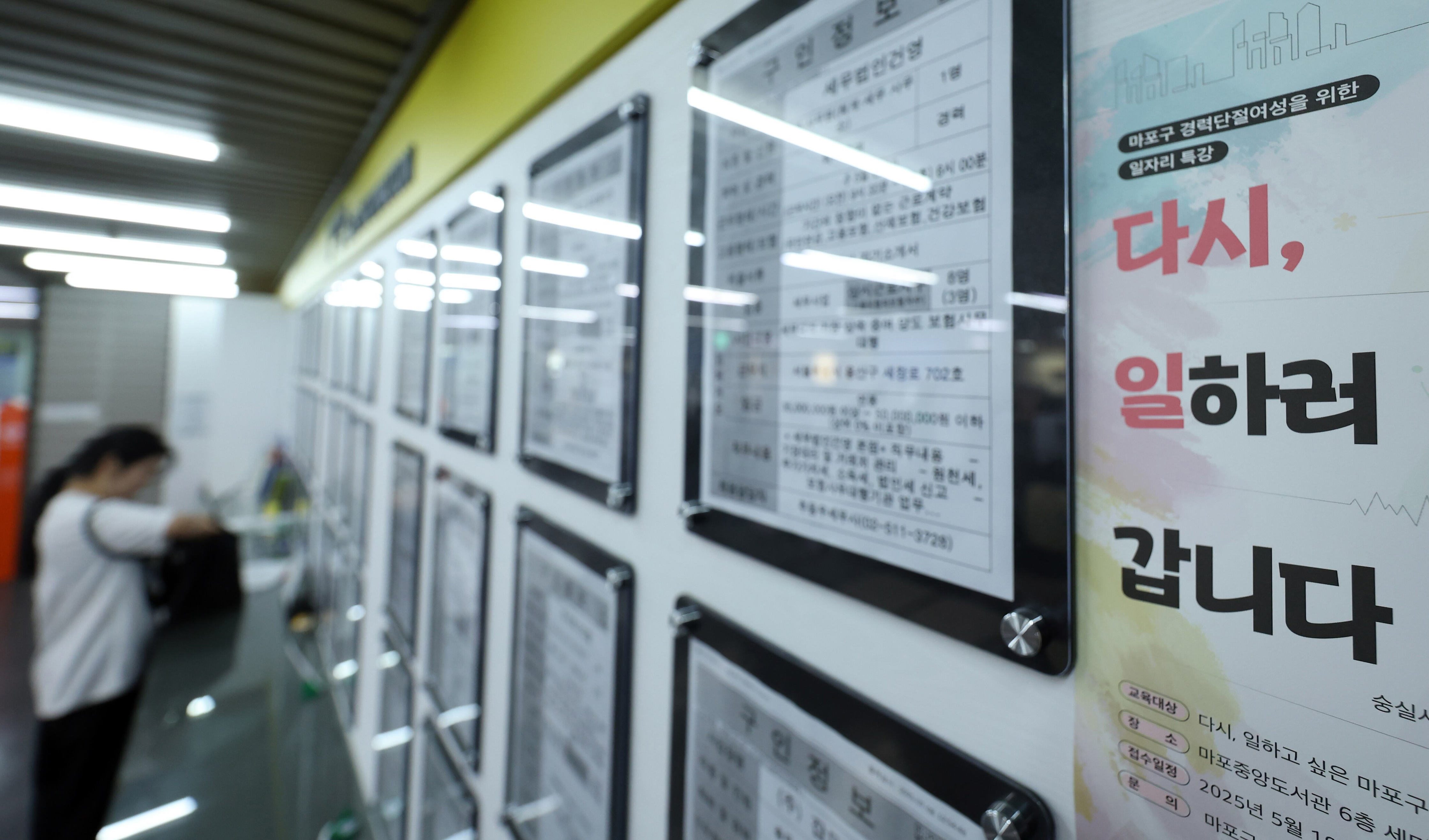
Young South Koreans are departing their initial jobs at an earlier stage, with the average length of employment decreasing by almost a year—the biggest drop in 15 years. Over half of those who left mentioned discontent with work conditions, including salary and hours, as the main cause.
On July 24, Statistics Korea published the "Supplementary Survey on Youth from the May 2025 Economically Active Population Survey," indicating that the average duration for post-graduates in their initial jobs was one year and 6.4 months. This represents a decrease of 0.8 months compared to the previous year, reflecting the largest drop since 2010.
The typical duration to secure a first job has decreased slightly, now standing at 11.3 months, which is 0.2 months quicker than previously. New employees tend to switch jobs approximately one year after they were hired, spending an equivalent period in the hiring process. Song Jun-haeng, head of employment statistics at Statistics Korea, mentioned, “Most young people in Korea are employed in sectors such as hospitality and restaurants, manufacturing, wholesale, and retail trade. The current decline in manufacturing seems to be impacting youth employment as well.”
The primary cause (46.4%) for young people leaving their jobs was dissatisfaction with working conditions. Temporary or contract work came second (15.5%), followed by issues related to health, childcare, personal matters, and family responsibilities (13.7%). When they started their first job, 39.7% earned between 2 million and 3 million won monthly, 28.3% earned between 1.5 million and 2 million won, and 11.1% earned between 1 million and 1.5 million won.
A profession that was once very desirable—public administration—is becoming less attractive. Within the group of people not participating in the labor force—those who are neither working nor seeking employment—14.5% were getting ready for entrance exams. Out of these, 36.0% were studying to join private firms, whereas only 18.2% were preparing for standard civil service roles.
Last year marked the first time that the percentage of individuals preparing for roles in the private sector exceeded those targeting general civil service positions. The difference has continued to increase since then. Prior to last year, 29.7% were preparing for private companies, compared to 23.2% seeking civil service jobs—a gap of 6.5%. By 2025, this gap had expanded to 17.8%.
Graduates with their latest degree are facing extended periods of unemployment. Individuals who have been out of work for under six months made up 37.7% of the total, a decrease of 0.3% compared to May 2024. Those who have been unemployed for three years or longer increased by 0.4% to 18.9%. Among young jobless individuals, 40.5% were participating in job training or studying for employment exams, 25.1% were spending time idly, and 10.7% were continuing their education.
Both the rates of youth employment and unemployment decreased. As of May this year, the youth employment rate was 46.2%, a decrease of 0.7% compared to the previous year. The unemployment rate also reduced by 0.1% to reach 6.6%. Consequently, the economically active population dropped from 4.107 million last year to 3.943 million, and the labor force participation rate fell from 50.3% to 49.5%.
Song explained, "The labor force participation rate indicates the percentage of the population involved in economic activities. The fact that this rate has dropped below 50% suggests an increasing number of people who are not working and not actively seeking employment."