
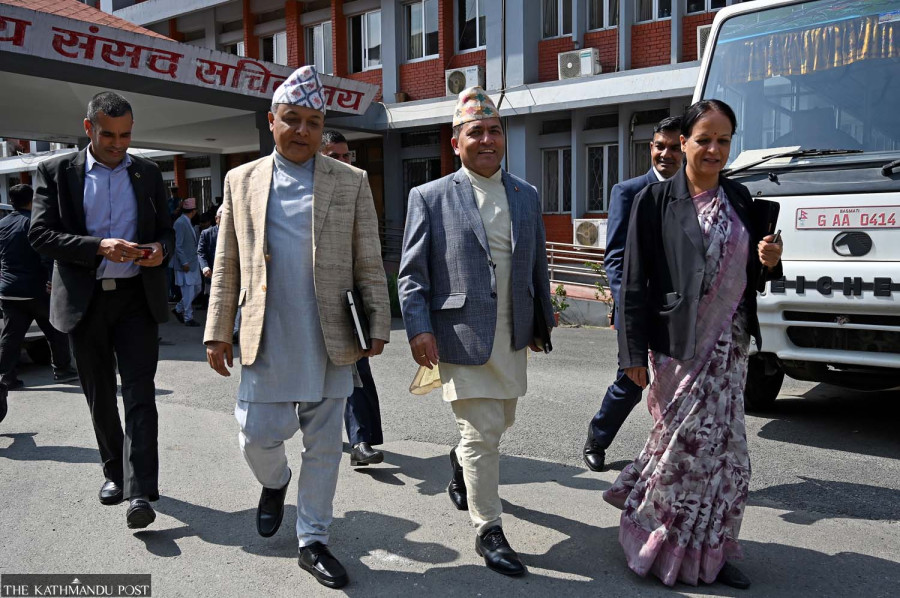
Kathmandu, July 28 — A legislative committee established to investigate the alteration of the cooling-off clauses in the Federal Service Bill has begun preparing its report following questioning of ministers, legislators, and officials involved in drafting the bill.
A seven-person committee established on July 7 was given 21 days to finish its work. Nevertheless, its inability to adhere to the deadline led Speaker Devraj Ghimire to prolong the period by a week beginning Sunday.
"We have already collected statements from the relevant ministers, members of the State Affairs and Good Governance Committee, and government officials, including the chief secretary and general secretary of the Parliament Secretariat," said Rosan Karki, a member of the investigation committee representing the Rastriya Prajatantra Party, to the Post.
Members of the probe committee state that government officials have acknowledged meeting with Prime Minister KP Sharma Oli and other senior political figures prior to the bill's introduction in the House. They also lobbied within the parliamentary committee to eliminate the cooling-off period, which prevents them from holding another government or constitutional position immediately after retiring or resigning. "It is not unusual for interest groups to advocate for their own interests," Karki remarked. "However, whether this actually led to any alterations remains a matter we are investigating."
The dispute arose when legislators found that the bill's version, approved by the lower house's full assembly, contained a provision regarding the cooling-off period that conflicted with the version agreed upon without opposition by the committee.
The original clause mandated that government officials must wait a minimum of two years following their departure from office or retirement before assuming political positions—a measure designed to promote ethical shifts in public service.
Nevertheless, the ultimate version approved by the House eliminated this limitation, sparking worries about procedural openness and possible political influence.
Members of the State Affairs and Good Governance Committee, including chairperson Ram Hari Khatiwada, assert that the contentious clause was secretly included in the bill prior to its submission to the lower house for approval.
Section 82(4) of the legislation specifies that any government worker who has stepped down or retired must wait for a minimum of two years before being appointed to another public position.
Nevertheless, in addition to the committee's decision, a subsection 82 (5) has been added to the bill, which conflicts with the previous clause, enabling civil servants to accept another government position within two years of leaving or retiring.
The investigation team headed by Nepali Congress member Jeevan Pariyar has been assigned four particular responsibilities: determining the method of the tampering; understanding the causes; identifying those who participated in the tampering; and suggesting remedial actions.
"Our panel is focused on gathering facts, not a judicial body that can accuse someone," said Ganesh Karki, another committee member from the Rastriya Swatantra Party, to the Post. "We hope it will find out who changed the bill. However, it's an open secret," he added without providing further details.
The House of Representatives is looking into the alterations made to the bill, while the National Assembly is scheduled to debate the legislation that has gathered 230 amendment suggestions from 46 legislators.
Three distinct types of amendments have been introduced in the bill by various political groups. The CPN-UML seeks to eliminate the cooling-off period, whereas the CPN (Maoist Centre) has suggested removing the "altered subsection" and extending the cooling-off period from two to three years. The Maoist Centre is the biggest party in the upper house. Members of the Nepali Congress support the removal of the "altered section."