
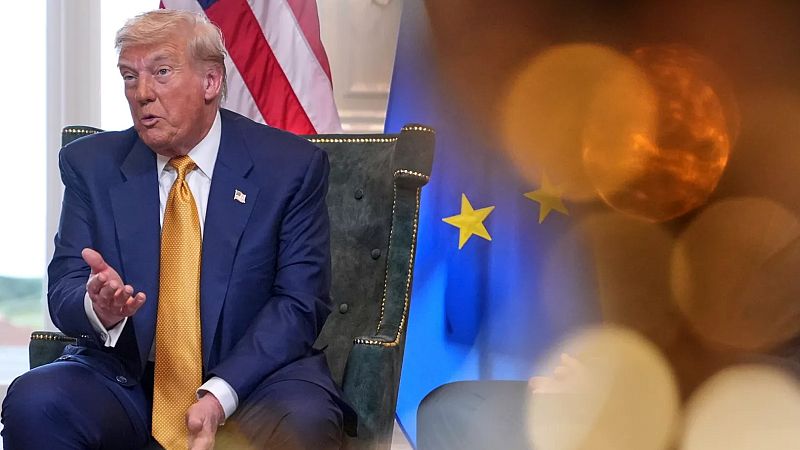
Following weeks of discussions, the EU and the US finalized a deal on Sunday regarding the tariff conflict that has divided them since mid-March: the EU will be subject to a 15% tax on its goods exported to the US, according to Commission President Ursula von der Leyen.announced.
We have set a consistent 15% tariff rate for the majority of EU exports. This rate is applied across most industries, such as automobiles, semiconductors, and pharmaceuticals," she stated, further noting, "this 15% serves as a definitive maximum - no additional charges, fully inclusive - providing essential clarity for our citizens and businesses.
Vehicles, which have been subjected to a 27.5% tax for several months, will now be subject to a 15% tax. A small success for German producers.
Von der Leyen also stated that zero tariffs will be applied to specific chemicals, certain generic medications, equipment used in semiconductor production, some agricultural goods (excluding all sensitive items such as beef, rice, ethanol, sugar, or poultry), some natural resources, and essential raw materials.
Nevertheless, doubts persist about the specifics and the industries included in the 15% rate, the legal clarity of the agreement made on Sunday, and the EU's commitment to purchasing and investing.
1. No enforceable contract has been established yet
The deal achieved will not be legally enforceable for both sides for a while. The exact timing is still unclear. A common statement is anticipated to be issued by August 1st—the deadline set by US President Donald Trump, who warned of imposing a 30% tax on the EU.
"A relatively modest joint statement is expected," an EU representative stated, noting that the EU is also waiting for the US to issue an executive order that would provide some clarity on the agreements reached. Until then, discussions regarding exemptions from the 15% tariffs will remain ongoing.
"Since we want to ensure that the US fulfills its obligations promptly, we will also aim to complete our part swiftly," the official stated, continuing, "We are currently examining the precise legal foundation in collaboration with the Council and the European Parliament." A bilateral international agreement between the EU and the US would require time, so alternative mechanisms could be explored by the Commission.
2. What EU products are excluded?
Aircraft will be excluded from the 15% taxes, allowing them to be shipped to the US without any duties. The manufacturing processes in these industries are closely linked, making it risky for the US to increase the cost of their aircraft.
Nevertheless, the EU will continue to discuss additional exemptions, with wine and spirits being a top priority. From the start of the negotiations,EU companies have consistently cautionedregarding the effects of an agreement that would impose penalties on them.
We genuinely believe that the wine trade is highly beneficial for both European Union and American companies, and it should be part of the 0-for-0 tariff agreement," said Marzia Varvaglione, president of the European Wine Companies Committee, in a statement on Sunday, and she added: "It's not only the EU side making this claim—our U.S. partners have also strongly supported safeguarding this essential trade.
3. Steel and aluminum: a quota system yet to be determined
The United States currently applies 50% tariffs on steel and aluminum. These will remain in place until both parties reach an agreement on a quota system. Nevertheless, the Commission is still confident about its influence during the upcoming negotiations. "I believe this is where economics and business interests come into play," said the same EU official, noting that the bloc's supply of specialty steel is something "the US manufacturing sector desperately requires."
However, the European steel sector seemed unsettled on Monday. "If a zero tariff on our conventional exports to the United States is confirmed, we would be moving in the correct direction," said Axel Eggert, director general of the European Steel Association (EUROFER), but he also noted: "There is still no clarity. As usual, the details make all the difference."
The doubt is balanced by the EU and the US's dedication to work together to address excessive global production capacities, primarily originating from China.
4. Energy: The EU's commitment to purchasing will be influenced by its industrial sector.
The EU has pledged to purchase $750 billion worth of US energy over the next three years. This equates to $250 billion each year allocated to the US liquefied natural gas, oil, and nuclear sectors. "We have been considering our requirements in relation to the gradual reduction of energy imports from Russia," an EU official stated.
Nevertheless, the official acknowledged that there is no public assurance of fulfilling this goal because the EU and its institutions will not be the ones making the purchases. "We can assist in consolidating demand and enabling certain processes, and we can examine where potential obstacles might exist in the infrastructure," the official mentioned.
The EU also pledged to buy US artificial intelligence microchips in addition to the $750 billion.
5. The EU's financial support in the US will be influenced by commercial factors
EU firms are set to invest $600 billion in the United States, as outlined in the agreement. However, once more, there is no public entity overseeing this process, unlike the Japan-US deal signed on July 22, which involves investments such as equity, loans, and guarantees provided by state-owned institutions.
Nevertheless, the Commission confirms it maintained thorough communication and conversations with various business organizations and companies to understand their investment plans.
We have essentially compiled our understanding of the investment plans of private companies. How this will be presented in the joint statement is that it's an intention," said another EU official, adding, "Therefore, it is not something the EU, as a public authority, can assure.