
By Kingsley Webora TANKEH
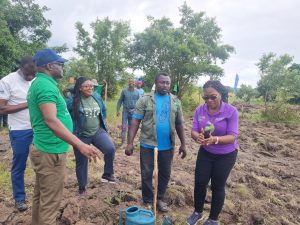
Ecobank Ghana, showing outstanding environmental responsibility, concluded its 2025 World Environment Day initiatives by planting approximately 1,700 trees at the Chipa Forest Reserve in Dodowa, Accra.
Working alongside the Forestry Commission, Ecobank has planted a total of 4,500 trees this year throughout the country, including the planting of 2,800 trees at 27 schools and hospitals in five regions of Ghana.
In alignment with the government's 'Tree for Life' program, this planting event seeks to restore the depleted tree cover in this essential forest reserve, which has been affected by unlawful logging and intrusion. The initiative includes planting approximately 1,700 trees across two hectares of damaged land within the next two weeks.
The effort is a component of the bank's long-term dedication to environmental responsibility and the move towards extensive, eco-friendly restoration projects. World Environment Day is observed worldwide on June 5 each year; nevertheless, the government has set aside June and July to commemorate this year's World Environment Day.
EcoBank's enhanced 2025 World Environment Day initiatives involved taking part in the official unveiling and a memorial tree-planting event at Kwabenya Community SHS on June 5. The company also took part in a unique tree-planting initiative organized by members of the Diplomatic Corps and leaders of certain institutions at the Achimota Forest Reserve on June 20.
Representing Tara Squire, the Executive Director of Ecobank Ghana, Dr. Daniel Kasser-Tee, Head of Corporate Affairs, spoke at the event held at the Chipa Forest Reserve, highlighting the Pan-African bank's dedication to promoting environmental sustainability initiatives in Ghana.
“Today, Ecobank is beginning a new phase,” said Dr. Kasser-Tee. “We are shifting from symbolic tree-planting to genuinely restoring degraded environments. Our focus on planting trees comes from the clear understanding that forests serve as a strong means for ecological recovery and long-term development.”
Dr. Kasser-Tee highlighted that environmental restoration fosters habitats for diverse species, boosts soil health, stops erosion, and increases water storage; therefore, it should be given top priority.
He emphasized that one fully grown tree can provide enough oxygen for as many as four individuals each day and can absorb 13 pounds of carbon per year, asserting that planting trees is essential in combating the climate crisis. Furthermore, tree planting also offers economic and social advantages to communities—such as job creation, enhanced quality of life, and visual appeal that can boost tourism.
"This is fundamental to Ecobank's identity as the leading Pan-African banking institution," Dr. Kasser-Tee stated, highlighting that the bank is also working to minimize its operational carbon footprint by implementing sustainable supply chains, energy-efficient buildings equipped with solar panels, and digital financial inclusion programs that encourage paperless banking.
Mrs. Linda Zuri Ansah, the District Manager of the Tema/Ada Forest District, expressed her appreciation for EcoBank's collaboration, emphasizing the importance of corporate involvement in Ghana's initiatives to revive its significantly damaged forest areas. "The government alone cannot rejuvenate our depleted reserves," Mrs. Ansah stated. "Unlawful logging and sand mining have caused considerable damage. We are excited that EcoBank is working with us to restore the Chipa Forest Reserve."
Mrs. Ansah outlined the commission's strict methods for guaranteeing the trees' survival, such as precise spacing for easy weeding and beat ups (replacing dead saplings), the creation of fire belts, and additional watering.
Connecting the project to the 2025 ‘Forests and Food’ theme of the Tree for Life campaign, Mrs. Ansah described the creative “Taungya” approach incorporated into the restoration plan. Farmers grow food crops among the young trees and get 100 percent of the food yield. When the trees are ready, farmers also receive a 40 percent share of the income from the timber. As she mentioned, this establishes a long-term motivation for maintaining and safeguarding trees in Forest Reserves throughout the nation.
Dr. Kasser Tee ended by appealing to all individuals to support initiatives aimed at bringing back Ghana's lost forest cover. "Planting trees should be a top priority for everyone," he emphasized. "If each adult Ghanian planted one tree per year, we could collectively plant more than 20 million trees every year. This would significantly help in restoring our rapidly deteriorating forests."
He disclosed that he has planted 19 trees on his own since late June, inspiring both coworkers and residents to follow suit. He encouraged people to think about planting trees in their backyards, gardens, and any available areas to help safeguard the environment.
In 2013, Ecobank Ghana collaborated with the Forestry Commission to celebrate World Environment Day. Over the last 12 years, it has continued to support this environmental initiative, carrying out tree-planting efforts every year.
Provided by SyndiGate Media Inc. (Syndigate.info).