
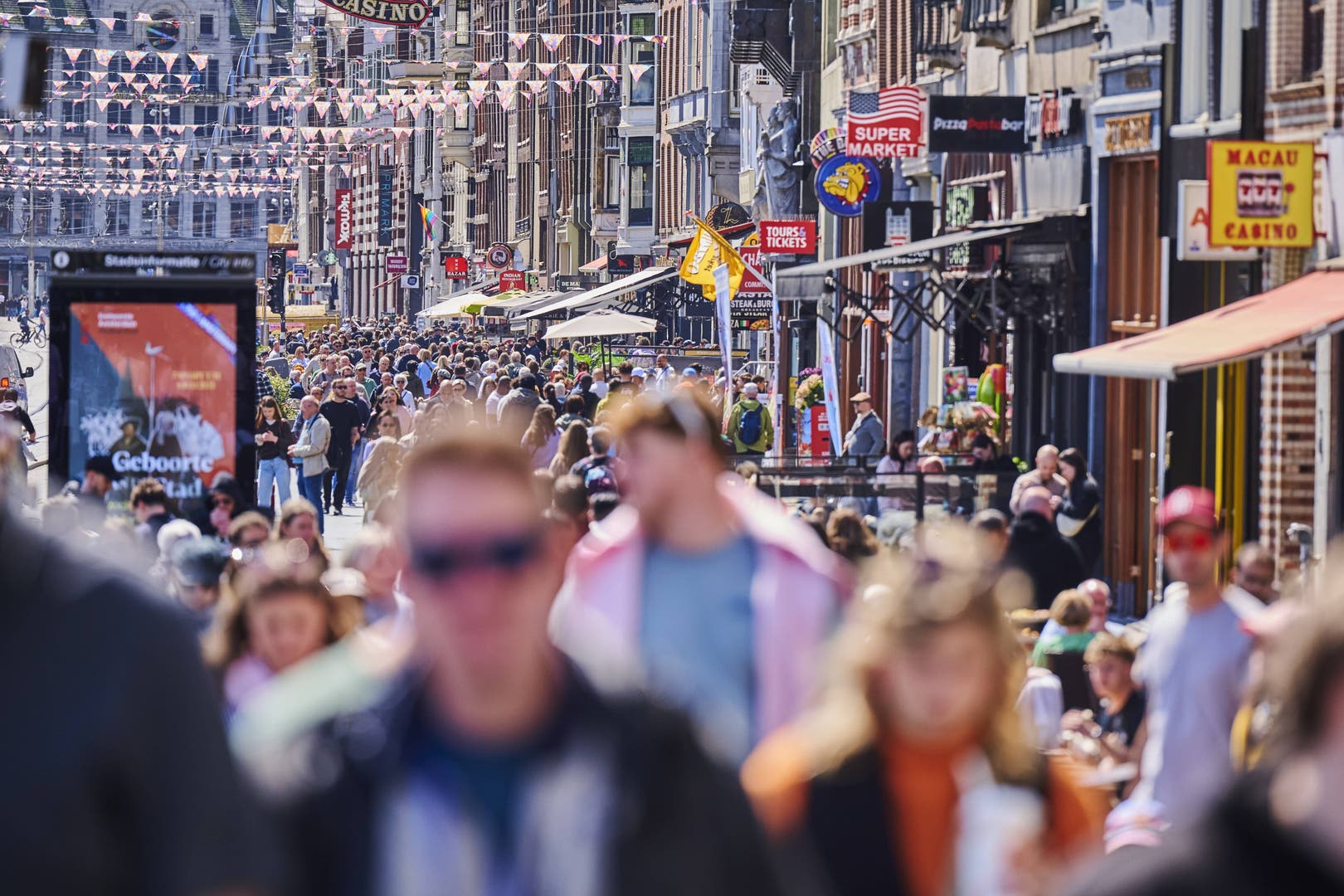
The Fries That Attract the World
It's not just about the quality of the fries. They are crispy and the truffle mayo sauce is delicious – but similar options can be found in many other snack bars in Amsterdam. So why do several dozen people stand in a line that stretches across the street, kept somewhat under control by security personnel, crowd control barriers, and information boards?
The answer lies with TikTok. Influencers have created a real buzz around the restaurant called «Fabel Friet,» which opened in 2020, and their posts have been clicked on millions of times. As a result, some visitors wait up to 40 minutes to taste what are said to be «without a doubt the best fries in Amsterdam.»
For some residents, however, Fabel Friet has become one of the most striking symbols of a development they no longer accept – the much-lamented phenomenon of overtourism. Now it's coming to a legal showdown, as a group of residents is suing Amsterdam's city authorities, accusing them of not keeping their word. «We don't do this with pleasure, but we have no other choice,» says Jasper van Dijk, one of the founders of the citizens' initiative.
A Growing Concern
Over a million more every year, the number of overnight stays in Amsterdam has continued to rise. The background to this is an ordinance from the summer of 2021, which pledged to limit annual overnight stays in the city to 20 million. However, the figure has increased by more than 10% year on year, except during the pandemic slump. While there were 14 million overnight stays in 2014, this figure had risen to over 21 million by 2019. Amsterdam has thus become the European capital with the most tourists per resident.
The effects are evident in other holiday hotspots such as Venice, Barcelona, and Lisbon. Local businesses and major booking platforms are doing well, government revenues are rising, and the cities are becoming more colorful – but resistance from locals is growing. Roads, sidewalks, and public transportation are overloaded, real estate prices are rising, long-established stores are disappearing, and noise and trash are increasing.
A Movement for Change
Four young locals – two economists and two lawyers – didn’t want to stand by and watch this trend continue in Amsterdam. Shaped by their impressions of the pandemic, when the city was quieter than ever before, they began meeting regularly in 2020 and set themselves the goal of «reclaiming» their city. The movement’s slogan: «Amsterdam has a choice.»
In the same year, local activists launched a petition calling on the authorities to take binding measures against mass tourism. Even without a large-scale advertising campaign, over 30,000 signatures were collected within two weeks, suddenly bringing their cause to the attention of politicians. Then the city council was forced to deal with it.
A Liberal State in Question
The young residents of Amsterdam had clearly struck a chord. The petition was supported by all political parties in the city council, with 44 of its 45 members voting in favor of it. In 2021, the council finally passed the ordinance limiting overnight stays to 20 million a year.
This figure is now at the center of the current legal and political debate. As part of the ordinance, the city authorities decided on a whole series of measures designed to limit the number of tourists visiting the city, such as one saying that no new hotels may be built and that existing ones may not be expanded. The visitor tax has been increased to no less than 12.5% of the price of accommodation, making it the highest in all of Europe. Airbnb accommodations can be rented for a maximum of 30 days or even just 15 days in some cases, depending on their location. Smoking is now only permitted indoors in the city's famous pot-selling «coffee shops.» Bars have to close earlier. Starting in 2026, only 100 cruise ships will be allowed to dock in Amsterdam each year, and the number of river cruise ships will be halved.
In short, the widespread image of the liberal Dutch state, in which market forces are free to operate, is now only true to a very limited extent, at least in Amsterdam.
Growth Unabated
But what happened after these massive interventions in the tourism sector? Nothing, or at least not what the initiators of the citizens’ petition had hoped for. More and more visitors are flocking to Amsterdam. Last year, the number of overnight stays climbed to 22.9 million – a record, but one that is unlikely to stand for long. The city's own statistics authorities predict 25 million overnight stays for the coming year in their «middle scenario.»
These are partly the result of decisions made years ago. A ban on new hotel construction has already been in place in the city center since 2017. However, exceptions have been permitted for sustainable projects, and these have also been granted regularly. The luxurious Maritim Hotel, with almost 600 rooms, will soon be opening in the immediate vicinity of the main railway station.
Even various tourism-industry players are saying off the record that the Airbnb regulation is a «joke.» There are hardly ever any checks, they add, so people and companies renting accommodations consistently violate the rules. The authorities vehemently deny this claim. For example, Sofyan Mbarki, the city councilor responsible for this issue, says: «We carry out both online checks and on-site inspections. Violations are punishable by fines of up to tens of thousands of euros, depending on the offense.»
Powerless Against a Global Trend
However, Amsterdam's government also feels somewhat powerless in the face of global developments. «Global tourism has picked up strongly again,» Mbarki says. «Amsterdam is following this trend.» Thanks to Schiphol Airport and Amsterdam’s proximity to other cities, more than 20 million day tourists visit the «Venice of the North» every year, undeterred by artificially inflated accommodation prices.
Jasper van Dijk and his colleagues are not impressed by these arguments. While acknowledging the efforts made by the authorities, they also say that the measures do not go far enough. «We have nothing against tourists; we are tourists ourselves sometimes. We are only opposed to the excesses – and believe that 20 million overnight stays is already a lot when compared to previous years,» says van Dijk, taking a sip of beer at a bar called De Engelbewaarder, one of the last establishments in his neighborhood that has not yet completely switched to catering to tourists.
Resistance and New Ideas
The heads of the citizens’ initiative have no shortage of ideas. The city should buy up hotels to create living space, they say. It needs to introduce cannabis ID cards so that only locals can buy marijuana in coffee shops in bulk, they continue, and the Red Light District should be forced to relocate outside the city center. Above all, however, the citizens’ movement wants to significantly increase the already record-high tourist tax.
However, resistance is forming against such radical plans. Its leading voice is KHN, the influential hospitality-sector association. Not only is KHN resolutely opposed to more restrictions, but it also believes that the status quo goes too far – especially the 12.5% tourist tax. «Our legal analysis is clear: This levy is intended to fund tourist infrastructure, but certainly not as a means of controlling visitor numbers,» says KHN media spokesperson Eveline Doornhegge, adding that KHN will take legal action against this «unfair practice.»
Striking a Balance
The authorities in Amsterdam are not to be envied. Although their city is high on the «bucket list» of millions of people, they are being confronted with legal challenges from both those who want fewer tourists and those who make their living from them. «Residents, business owners and visitors are not adversaries,» says Mbarki, the city councilor. «The city belongs to everyone, and we are working to strike the right balance.»
Until then, visitors to Fabel Friet in the trendy Negen Straatjes, or «Nine Little Streets,» neighborhood will probably have to wait a while before they get their fries. However, the fate of such trendy restaurants is sometimes uncertain. For example, long lines used to form in front of a shop offering vegan ice cream from Oatly. But the shop has been closed since 2023.