
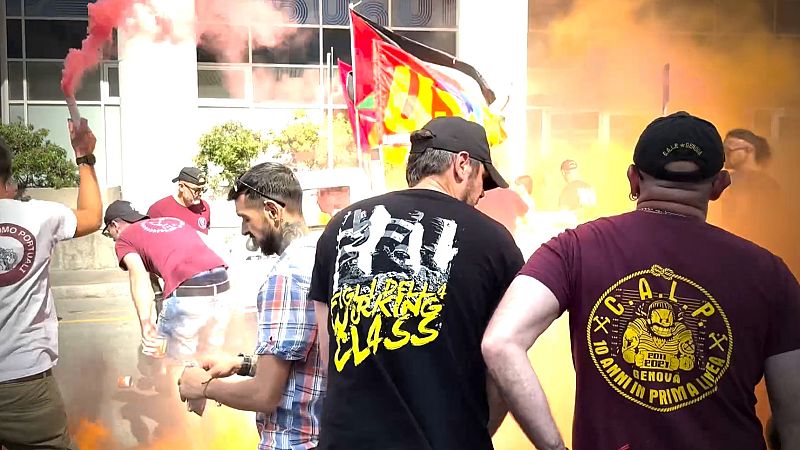
European port workers are urging EU nations to stop the transport of weapons and remove official backing for Israel.
They emphasize that international agreements stipulate that arms should not be sent to conflict areas where fundamental rights are breached.
"Over the last two years, there has been a rise in the transportation of arms via commercial ports," states Josè Nivoi, a prominent member of the Genoese dockworkers' union.
We have submitted several legal complaints. A common justification they provide is that they present it as a private deal instead of a government-to-government arms transfer — as if it were trading bananas.
For many years, Nivoi has gathered information regarding weapon shipments in the port while serving as a union representative. Dockworkers allege that officials are intentionally remaining quiet about disputed cargo.
In Italy, Law 185 from 1990 generally forbids the movement and transport of weapons to nations involved in conflict. We are urging civilian ports not to be utilized for transferring arms.
In 2024, Italy declared that it had halted the delivery of military supplies to Israel, while maintainingagreements concluded prior to October 7, 2023. This amounts to more than €6 millionin arms, bullets, repair, and replacement components.
Data and statistics regarding Israel's military equipment acquisitions
Israel imports almost 70% of its collection from theUS, the top global arms supplier.Germany is Israel's second supplier. Since October 7, 2023, it hasexported 485 millionWeapons worth euros. Italy is in third place, providing less than 1%.
The UN Treaty on Arms Trade and the European Common Positionstate that breaches of human rights and acts of war should hinder these transactions. TheEU Council Common Positionis legally binding, but it does not have enforcement.
Member states may have varying interpretations. After the Israel-Hamas conflict in Gaza, Italy, Spain, Belgium, and the Netherlands have paused or limited exports.
Hamas' weaponry receives minimal oversight, primarily sourced from Iran, which has not ratified the UN Arms Trade Treaty.
Why do European Union nations provide military assistance to Israel?
The European Union recently determined that Israel isviolating its human rights responsibilitiesIn Gaza, so why does Israel continue to get military backing from European nations?
Giorgio Beretta, a leading Italian expert on the arms trade and a consistent representative of the Italian Peace and Disarmament Network, states that agreements are optional and each nation must pledge itself to them.
"The rules are solid. The issue is with their implementation, as there is always a large degree of flexibility," states Giorgio Beretta from the Permanent Observatory on Small Arms, OPAL.
Beretta claims that the data shared with national governments, which are tasked with preventing weapons from being used in human rights abuses, is frequently insufficient.
A broad classification could be mentioned, like 'aircraft' or 'naval ships', but there is a significant difference between aircraft used for ground assaults and those used for rescue. By the time a parliament examines exports, the weapons are usually already delivered.
In May, the EU declared an examination of the EU-Israel Association Agreement following its determination that Israel had violated the trade deal's human rights provisions, referencing infractions in Gaza and the West Bank.
By July, the EU had delayed any measures, let alone penalties, such as a potential arms ban — once more revealing its long-standing disagreements regarding Israel.