
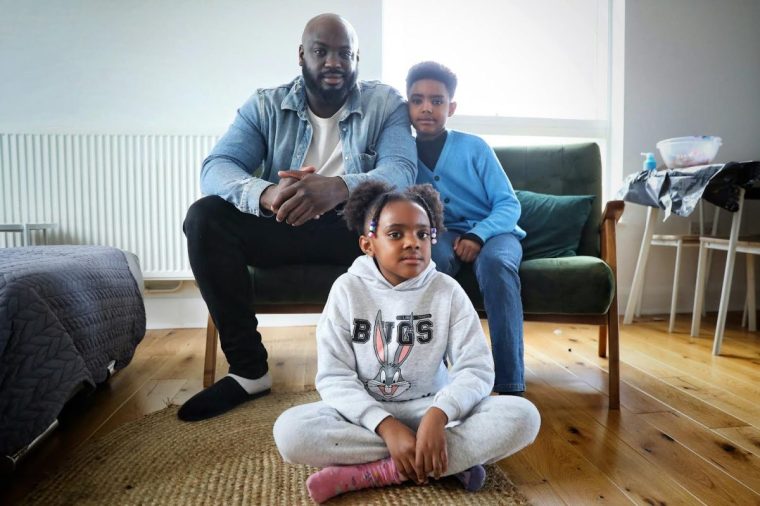
When Marvyn Harrison welcomed his first child, his aim was simple: take two weeks off work to get used to life with a newborn. However, it soon became apparent that this plan was "not really feasible." As a contractor working for a tech company, he wasn't eligible for any paid leave, so he would have to take it without pay. The expenses related to caring for a baby were quickly increasing.
I spent four days before I understood that the stress of having to cover all expenses for the entire month was simply too much," he says. "I decided that by Monday of the following week, I would return.
So Harrison, who is 41, spent only a week on itpaternity leave, for which he was given statutory pay – below half of the UK's minimum wage. In the UK, new fathers are currently eligible for two weeks of government-supported leave at a rate of either £187.18 per week or 90% of their average weekly earnings – whichever is lower; this is the least generous in Europe.
At the beginning of this month, officials initiated an assessment ofpaternity leave and parental rights, which Business Secretary Jonathan Reynolds called "our opportunity to reset the system and create something that benefits modern families." Proposals could include unpaid leave being available to employees from their first day.
Many people find the system ineffective. Last month, hundreds of demonstrators from the campaign group Dad Shift marched in London and Edinburgh to advocate for improved rights for fathers.
In 2014, the government launched shared parental leave (SPL), which enables parents to divide 37 weeks of paid leave at the statutory minimum rate and an additional 13 weeks of unpaid leave. However, less than two percent of new parents utilized this option last year. A 2023 government review found that 45 percent of fathers were not aware of this possibility, likely because of inadequate promotion of the policy and financial limitations. Another challenge is that when couples opt for shared parental leave, mothers must conclude their maternity leave early—something many are reluctant to do.
Common issues drive dads back to worksooner: that men usually earn more (a significant factor, considering the UK is the third most costly country in the OECD for raising a child, averaging £12,400 annually), and that women are often regarded as the main caregivers, even though this affects their professional advancement.
I felt scrutinized by friends and family for returning to work too soon
However, returning to work quickly is negatively impacting fathers, according to Harrison. Being back at the office just a week after his son's birth "wasn't a pleasant experience. I felt constantly guilty.".I also felt judged by friends and family who said, "You're back at work already?" I felt I had to push myself to discuss my financial situation to explain why I wasn't staying home with my baby, which is where I truly wanted to be.
For many years, Harrison states, he found himself constantly playing catch-up—making an effort to connect with the baby he had initially been unable to spend time with, all while managing the stress of holding down three jobs to support his family financially. He now realizes that this situation led to a period of depression.
Read Next: We departed London for Scotland – we have more room, but it took years to feel at home.
I used to arrive home after work on a completely different wavelength, failing to understand what the house required and who I needed to be. It was an ongoing sense of separation," says Harrison. "If I had that time at home, we could have built a culture and routine together. That was the missing piece.
I faced significant challenges. It was an extremely difficult period, and it took roughly two and a half years to move past it.
Pete Target served as a government employee, but after becoming a father, he received only one week of full salary, followed by another week at the legally mandated minimum, causing him to experience feelings of inadequacy both in his job and at home.
But taking an extended period offLast year, before his son's first birthday, when his partner went back to work, it made all the difference, he says. "I always knew, throughout my entire life, probably, that I would want to take as much time off work as possible to be with my child."
Although he faced financial difficulties, he spent nine weeks traveling to the city farm, having picnics, and visiting the aquarium with his son – along with participating in a demonstration for the Dad Shift. (Shared parental leave can be utilized at any point before your child's first birthday.)

It was truly frightening and difficult, having all this unplanned time," he says. "But very soon, I discovered that I enjoyed the opportunity to build my own bond with my son... it was incredible," says Target, 37. "I quickly felt like I was becoming the main parent.
By the conclusion of their time spent together, his son's bond with him was clear-cut. "A bit enviously, I truly, deeply wished that if he fell down, he would call out for me. Because that meant a lot to me; that there was such a level of mutual connection," Target says.
If I have another child, I'll take twice as much time off
He acknowledges that the focus on him being theprimary caregiverBeing in public was different from what mothers usually go through. "I was very aware that this was something my partner hadn't necessarily experienced. I felt like a cool guy, walking around, doing something pretty much right and progressive. I won't deny it, that definitely happened," he says about the positive reactions from people around him. "And it was really encouraging."
The experience was extremely positive, with him saying, "If we have another child, I will take twice as much time off." He views it as an essential chance to build a strong bond with his child. "It truly strengthened and deepened the relationship between me and my son. I just hope everyone can have that opportunity." He encourages other fathers to do the same, even if financial concerns seem difficult, noting that if both parents earn similar incomes, there's essentially no real loss.
Harrison, whose kids are currently nine and seven, thinks that significant changes are needed in the UK to create a fairer environment betweenworking parents"Employers should adopt a more favorable approach towards employees who are starting families and offer greater assistance," he states.“Not everyone can afford to hire nannies or au pairs... not everyone has grandparents, aunts, and uncles who can offer assistance.

He also strongly believes that laws focusing on men's role in family life have never been a priority for any government, and that not addressing this issue is "leaving mothers overworked and emotionally overwhelmed due to the absence of fathers." He states that "they have 100 per cent the ability to bring about change," emphasizing that it shouldn't be about "whether the Government or employers think it's feasible. It's simply about whether we are ready to take this step for men."
dadshift.org.uk